COLOR ANALYZER INSTRUMENT DESIGNS
| ...... |
|
| ...... |
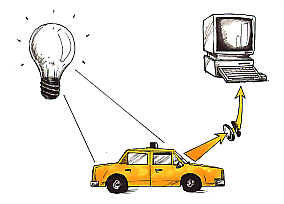
Color instruments have a variety of designs depending on the object to be measured and the type of colorants in the material. The color analyzer needs to receive the light signals from the measurement and divide them into the sampling of the spectrum for conversion of light energy to electrical energy. The traditional instrument was a colorimeter, which had broad band filters that were designed to give a red, green and blue response similar to the cone cell response in the human eye. These are called filter colorimeters.
Spectrophotometers originally had scanning devices that broke up the light signal across the spectrum and could be sampled at 1nm, 2nm, 5nm, 10nm, or 20nm intervals. This concept is still used in analytical spectrophotometers and a few color instruments.
Lower-cost, abridged spectrophotometers are often designed with narrow-band interference filters set at 10 or 20nm spacing with an individual light detector behind each filter. These instruments are dependable but subject to the quality of the filters. The best quality instruments use oxide filters. Low quality instruments use gel filters.
Holographic gratings, which are like special-etched mirrors, are used in most high-end color instruments. The light is aimed at a diode array, which converts the light signals to electrical, and then data response that becomes the color measurement at 5, 10, or 20 nm intervals.
LED-based instruments use silicone detectors, which provide full spectral response, low-cost and dependable results.
| ................. |
| <COLOR ANALYZER INSTRUMENT DESIGNS> |
| ................. |
| Click Here To Continue. |
| ................. |
| Copyright © 1998-2009 ColorTec Associates, Inc. All rights reserved. All other manufacturers’ trademarks acknowledged. |
| ................. |