COLOR COMPUTER COLOR DATABASE
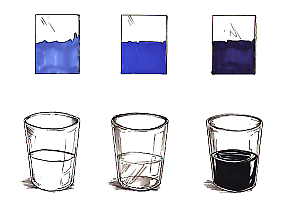
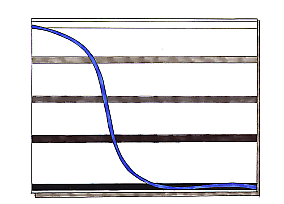
We showed how white, black and a series of grays are used to begin calibration of a particular set of colorants (a color palette). For each of the basic colors used for color mixing, such as blue, green and red, we also have to make a series of samples for the color computer. Usually we make a mixture with white and with a gray (black plus white) and with the clear polymer mixture (without white or black) called a mass tone. These samples are carefully weighed up and prepared similar to the way the materials are used in the process. When fully cured, the samples are measured on a color instrument (spectrophotometer). The program in the color computer creates an analysis of the absorption (K data) and scattering (S data) across the spectrum for white, black, and all of the colorants. This is the data that the color computer uses to predict color mixes after you measure a color to be matched.
|
|
|
When all of the colors to be used for color mixing have been calibrated, a series of known mixtures are made. The way we tell if the color computer will do a good job is to measure these known mixture samples and let the color computer predict the mixture used to make the samples. If the color computer gives accurate back predictions when compared to the actual formula, then we know that the database will be dependable in prediction of new colors and correction of production batch mixes.
The development of better color computer mathematics adds new ways of making samples that give better accuracy in mixture prediction over a wider range of color concentration possibilities. The ability of color computers to give dependable color mixing predictions is highly dependent upon consistent reliable colorants and other key materials, precision and consistency in measuring of material quantities, and mixing procedures.
In addition to the technology for opaque materials just discussed, color-mixing technologies also are available for other types of colorants and processes:
1.) ... Textile Dying uses a series of concentration samples prepared with each of the basic fiber types. Since most dyes create color by chemical reaction with the fibers the chemistry and process parameters in preparing the color matching database must be true to the actual production process. Since the dyes become part of the fiber, the fiber color itself becomes the "white" of the matching mathematics. Thus this mathematical model calculates the K (absorbance of the dye) divided by the S (scatter of the dye). This is referred to as K/S factor and often referred to as "single constant" color matching. Analytical tools in the software provides the analysis of dye "build-up" as the concentration of the dyestuff increases in the dye bath. One of the problems of Dye concentration and mixture prediction is that each of the colors are competing for the chemical dye reactive sites on the fiber surface. Some dyes are more chemically reactive than others, so that mixture prediction may not give the best mixture to meet the color match goals. The mathematics is driven by the relationship of the dyes to the materials to be dyed.
2.) .. Lithographic Ink also is transparent and uses concentration samples and single constant K/S mathematics. The white of the printed substrate is the white and the concentration samples are created by dilution of pure base inks with a clear resin base ink. The formulas are expressed based on the ratio of fully constituted inks intermixed to achieve a given color at a repeatable film thickness.
3.) .. Transparent Materials can be matched using a series of concentration samples mixed with a common solvent in the case of liquids or formulated at different concentrations of clear resin in the case of clear plastic films.
| ...... |
| <COLOR COMPUTER COLOR DATABASE> |
| ...... |
| Click Here To Continue. |
| ...... |
| Copyright © 1998,2009 ColorTec Associates, Inc. All rights reserved. All other manufacturers’ trademarks acknowledged. |
| ...... |