There are colorants that create unusual absorbency and scattering effects.
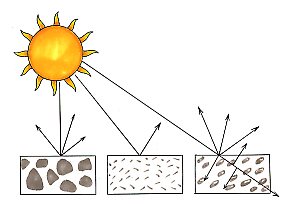
<SPECIAL EFFECTS COLORANTS>
Copyright © 1998,2009 ColorTec Associates, Inc. All rights reserved. All other manufacturers’ trademarks acknowledged.
SPECIAL EFFECTS COLORANTS
|
There are colorants that create unusual absorbency and scattering effects. |
|
| - Fluorescent materials absorb light at one wavelength and emit the light energy at another. Often the light energy is absorbed in the UV range, outside the visual range, and emitted in the visual range. This is what creates bright "poster" type colors. Optical brighteners (bluing agents) used in paper and textiles are another example. | |
|
|
| ..................... | |
| - Metallic pigments are usually aluminum or other metal flakes used in automotive coatings, some plastics, and printing inks. They can be thought of as tiny mirrors, they add only a gray nonselective color effect of their own, but based on their particle size distribution, they can shift (flop) a color when looking at a sample from several angles. Changing metallic pigment quantity or the particle size distribution or even the way you prepare a sample can have a great effect on lightness color measurement data. Uniform sample preparation is the key to preparing matches in metallic materials. Color instruments that measure at several angles (goniophotometers, both colorimeters and spectrophotometers) are often used to measure samples with metallic pigments, and color-mixing math has been developed to rematch known colors. This is an area where much development work is still in progress. | |
| .......................... | |
| - Pearlescent pigments are mica flakes that have been coated with TiO2 or other selective pigments. They are semitransparent and allow some light to pass through their surface and absorb and scatter light as well. The net effect is to bend the light waves and create a multicolor effect, such as oil on water. The color and appearance as well as the safety of "pearls" have earned them a place in many paints, inks, plastics, and even cosmetics. They can be used in a base white formulation color matching database, and other colorants can be added to match a particular end color. There is a great deal of work being done in color measurement with multi-angle instruments, but like metallics, process procedures can easily effect the final color.
<SPECIAL EFFECTS COLORANTS> Copyright © 1998,2009 ColorTec Associates, Inc. All rights reserved. All other manufacturers’ trademarks acknowledged. |