HOW DO WE PROGRAM A COLOR COMPUTER WITH THE HUMAN VISION RESPONSE?
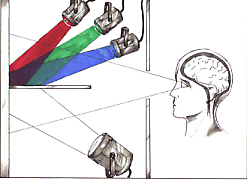
| - Experiments were done in the 1920's using observers working with devices that allowed the observer to mix red, green, and blue filtered light to match target colors created by another filtered light. The data was gathered after thousands of tests, and the results were calculated to define the human red, green, and blue response. |
|
- The international body called Commission International De l'Eclairage (CIE) reviewed the data from color mixing experiments. Based on the data, calculations were developed to simulate the average color matching characteristics of people having normal vision. (The R, G, B data was previously discussed as the retinal response.) The retinal response data is transformed to X,Y,Z as shown in the next section.
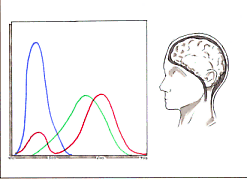 |
- The data was published by CIE in 1931 as the 2-Degree Standard Observer; and in the 1950s, the experiments were updated and the data published in 1964 as the 10-Degree Standard Observer. The difference in the Observer mathematics has to do with the design of the test apparatus and how much of the light illuminated the retina of the observers in the experiment. This data is used in all Color Computer programs as the basic information to calculate how the human sees color and is often defined in color computer programs as the Standard Observer (2- or 10-degree). Each will provide dependable data; however, the data should not be compared as the same. The most common standard used is the 10-Degree Observer. |
| ...... |
| <HOW DO WE PROGRAM A COLOR COMPUTER WITH THE HUMAN VISION RESPONSE?> |
| ...... |
| Click Here To Continue. |
| ...... |
| Copyright © 1998,2009 ColorTec Associates, Inc. All rights reserved. All other manufacturers’ trademarks acknowledged. |
| ...... |