COLOR IS THE PHYSICS OF LIGHT
Color begins with light. What do we know about light and color?
LIGHT:
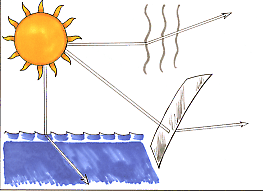
| -Light is a point source. Each light source comes from one point and travels in all directions. | ||
| -Light travels at the rate of 186,281 miles (300,000 kilometers) per second in the vacuum of space and slows as the material it passes through becomes denser. To give you an idea how fast light travels, light would go around the earth more than seven times in one second. That is why it is so difficult to study. | ||
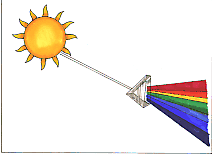
| -Light can pass through clear gasses, liquids, solids and a vacuum. When you change the density of the media, you slow the speed and bend the light waves in a predictable manner. This is called the refractive index of a material. The speed slows by a factor or 2-4 at most. The angle of light movement direction can change greatly depending on the material. | |
|
| -Light moves in waves of energy that can be measured in wavelengths in the spectrum of electromagnetic radiant energy states from the ultraviolet range (below 400nm to about 200nm) to the infrared region (over 700nm to above 2000nm). Units of measure of wavelengths are called nanometers. They are so small that the distance across the head of a pin measures more than one million nanometers. | ||
| - Wavelengths of light between 400nm and 700nm are the range of light energy where 99% of human color response occurs (called the visual range) and is commonly referred to as the visual spectrum. | |
|
| -Light can be selectively scattered and absorbed by some materials in gasses, liquids and solids. As a group, these materials are called colorants. | ||
| -Light energy can be absorbed in one area of the spectrum and re-emitted in another. This creates fluorescent colors and optical brighteners. | ||
| .... | ||
| <COLOR IS THE PHYSICS OF LIGHT> | ||
| .... | ||
| Click Here To Continue. | ||
| ...... | ||
| Copyright © 1998,2009 ColorTec Associates, Inc. All rights reserved. All other manufacturers’ trademarks acknowledged. | ||