THE OBJECT
COLOR IS THE PHYSICS AND CHEMISTRY OF MATERIALS
|
|
This next section is designed to introduce the user to the relationship between light and materials. In this series, most of the examples relate to materials colored with pigments, such as paints, plastics, and printing inks. Some comment will be made to dyes and textiles. In this series, we review the effects of the colorants on reflective color and set the basis for subtractive color mixing theory.
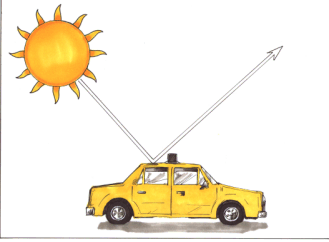
When light hits a material, it will strike the surface and, depending on the surface characteristics of the material and the angle that the light hits the material, it will reflect off the surface or go into the material. It usually does both.
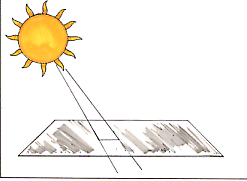 |
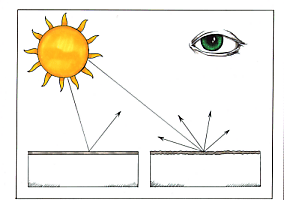
| The surface of a material will affect its appearance depending on the finish of the material. The smoother the surface, the more the light will bounce straight off. The color of the light that reflects off the surface of a material (first surface effect) will be the color of the light. The term used to describe this appearance is gloss or sheen. A material with a very smooth surface will appear to have a high gloss or sheen. If the surface is uneven, the light is diffusely reflected in many directions and the material appears to have a softer or flat look. This effect can be measured on flat surfaces with a device called a gloss meter which are designed to illuminate the surface at specific angles (i.e., 60 degrees) and report the gloss relative to a known glossy calibration plaque. Color instrumental readings can give you an idea of gloss change, if the only thing that is changing is gloss, by reading the L value. In 45/0 instruments, less glossy materials usually have a higher L value, and more glossy materials have a lower L value. | |
 |
|
| While in Sphere instruments the difference in L value between specular included measurements and specular excluded measurements is the effect of the gloss of the surface. When using sphere instruments, you need to study measurements taken specular included verses specular excluded. | |
WHAT CAUSES MATERIALS TO APPEAR COLORED?
When light hits the object, some of it will reflect off the surface. The rest enters the material. The light that enters the material can do several things:
| -It can pass through the material and come out the other side. We call these materials transparent materials, such as a glass of water. If we put clear dyes in transparent materials, we can absorb and filter out some of the light waves as we might do with a lens or a clear solution. | |
| - Or the light can be scattered and differentially absorbed and then be reflected back from the material, creating the color of that material that we see. Materials that only reflect light are called fully opaque. Some of the light may be lost in the surface and some is lost in the material. | |
| - Or some of the light passes through the material and some is reflected back and some is lost on the surface and some is lost in the material. These are called translucent materials. | |
| ...... | |
| <COLOR IS THE PHYSICS AND CHEMISTRY OF MATERIALS> | |
| ...... | |
| Click Here To Continue. | |
| ...... | |
| Copyright © 1998,2009 ColorTec Associates, Inc. All rights reserved. All other manufacturers’ trademarks acknowledged. | |
| ...... |